

The State of Israel
The Land of Israel, which the Bible claims was promised to Abraham, the father of the Israeli nation, to his son Isaac and his grandson Jacob, and to which their descendants, the Israelites, returned after being enslaved in Egypt for hundreds of years, is where the State of Israel was founded[1]. The Israelites appointed a ruler for themselves and created the undivided Kingdom of Israel, which subsequently divided into two kingdoms: Israel and Judah, after hundreds of years of temporary judges ruling the region that was frequently conquered.
The Northern Kingdom of Israel lasted until 721 BCE, at which point it was conquered by the Assyrian army[2]. Some of the Jewish people were banished. The majority of them stayed in the country, although a sizeable portion fled to Judah as refugees. The Temple was destroyed in 586 BCE when the Babylonians overthrew the Kingdom of Judah. Following the conquest, the majority of Judah's population was banished to Babylon.
Following the Persian conquest, Jews were granted autonomy, permitted to return to the land, and even had the Temple rebuilt (late 6th century BCE) thanks to King Cyrus's edict[3]. Later, near the close of the second century BCE, the Hasmonean dynasty, which rebelled against Seleucid power, led to the restoration of the Kingdom of Judah.
Pompey subjugated Judah in 63 BCE, turning it into a Roman protectorate[4]. The Great Revolt began in 66 CE as a result of several ordinances prohibiting religious practice[5]. After the Romans put an end to the uprising, Emperor Titus demolished the Second Temple, and Jerusalem was destroyed. The Bar Kokhba Revolt began in 132 CE[6]. After three years, the uprising was brutally put down despite the rebel forces' early successes.
From the fourth century CE to the twentieth century, the Land of Israel changed hands numerous times between invaders of various ethnicities, with the support of the region's leading countries. Jews have resided in and moved to Israel from all over the world for centuries, but a focused immigration of groups started later, the most well-known of which were the Hasidic students[7]. The formation of the institutionalized Zionist movement coincided with the start of major waves of immigration in the late 19th century.
As a continuation of the immigrant movement to the Land of Israel across the years, the State of Israel's history started with the awakening of Jews from all over the world to come to the Land of Israel. Many Jewish thinkers, including Rabbi Yehuda ben Shlomo Hai Alkalai, Moshe Hess, Rabbi Zvi Hirsch Kalischer, Yehuda Leib Pinsker, and Moshe Leib Lilienblum, who published books and articles asserting that the creation of a Jewish state was the answer to the Jewish people's predicament, advocated for immigration to the Land of Israel to establish a state there, that is, independent Jewish sovereignty[8].
Benjamin Ze'ev Herzl released his book "The State of the Jews" in 1896, outlining his ideas for a Jewish state[9]. In order to disseminate his ideas and secure a charter—permission from the Ottoman Sultan to settle Jews in the Land of Israel—Herzl made diplomatic contacts. Herzl was the leader of the political Zionist movement. Herzl, in contrast to other Zionist leaders, placed a high value on obtaining legal and international acknowledgement of the Jewish people's claims to the Land of Israel before the actual settlement.
The World Zionist Organization was established when Herzl called the first World Zionist Congress in Basel, Switzerland, in 1897.[10] The congress's description of "a national home for the Jewish people in the Land of Israel under the law of nations" was the Zionist movement's stated objective. The Zionist Organization started by setting up the necessary infrastructure for the creation of a Jewish state in Israel. This included managing foreign policy, establishing financial institutions, buying land (through Keren Kayemet LeIsrael[11]), and directing and supporting Jewish establishment in Israel. Herzl led the Zionist movement from its founding in 1897 until he died in 1904. One of the most prominent activists alongside Herzl, especially in the diplomatic field, was Chaim Weizmann, who became one of its leaders after Herzl's death and later the president of the State of Israel.
With the publication of the Balfour Declaration on November 2, 1917, which stated that the British government supported a national home for the Jewish people in Israel, the Zionist Organization's foreign policy saw tremendous success. After the British occupation of Israel during World War I came to an end, the proclamation gained its greatest significance. Based on this proclamation, the League of Nations granted Britain authority over the Land of Israel, subject to the creation of a Jewish organization to counsel the British on issues about the Jewish national home. This body was indeed established and was named the Jewish Agency.
On May 14, 1948, the State of Israel was founded with the proclamation of independence in the Land of Israel on 2nd Iyar 5708. At the time of its founding, it was home to more than 600,000 Jews, making up over 6% of all Jews worldwide[12].
In 2026, the population of Israel is estimated to be around 10.1 million. The population is distributed as follows: Jewish and others around 76%; Arabs approximately 21%; foreign residents: approximately 3%. The country's population growth rate is between 1% and 1.1%. The population is distinguished by a high percentage of young people, with a median age of roughly 29 years, and is primarily driven by a birth rate of 2.7%[13].
-
The Patriarchal Promise: The Hebrew Bible (Genesis 12:7, 15:18) details the covenant and promise of the land to Abraham, renewed with Isaac (Genesis 26:3–4) and Jacob (Genesis 28:13).
-
Fall of Northern Israel (721 BCE): Documented in II Kings 17. This aligns with Assyrian archaeological records, such as the Nimrud Prism, which notes Sargon II's campaign and population shifts.
-
Edict of Cyrus: The biblical book of Ezra (1:1–4) records the Persian decree allowing Jews to return and rebuild the Temple. The Cyrus Cylinder (housed in the British Museum) corroborates this imperial policy of restoring displaced populations.
-
Pompey's Conquest (63 BCE): Documented by Romano-Jewish historian Flavius Josephus in Antiquities of the Jews (Book XIV).
-
The Great Revolt (66–70 CE): Flavius Josephus's eyewitness account, The Jewish War, describes the Roman siege of Jerusalem, Titus's destruction of the Second Temple, and subsequent Jewish displacement.
-
Bar Kokhba Revolt (132–135 CE): Chronicled by Roman historian Cassius Dio in Roman History (Book 69) and substantiated by the discovery of the Dead Sea Scrolls and Bar Kokhba letters.
-
Hasidim Immigration: Historical accounts track the continuous Jewish presence and the specific late 18th-century migrations of the students of the Baal Shem Tov and the Vilna Gaon (1777–1808).
-
Leon Pinsker: Auto-Emancipation (1882).
-
Theodor Herzl: Der Judenstaat (The Jewish State), published in Vienna in 1896.
-
The Basel Program (1897): Official protocols of the First Zionist Congress state the goal of establishing a "publicly and legally assured home in Palestine."
-
Keren Kayemet LeIsrael (Jewish National Fund): Established at the Fifth Zionist Congress (1901) to acquire land.
-
Declaration of Independence: The official Declaration of the Establishment of the State of Israel, publicly read by David Ben-Gurion on May 14, 1948 (5 Iyar 5708).
-
2026 Demographic Statistics: These figures align with the official tracking, press releases, and statistical abstracts published by the Israel Central Bureau of Statistics (CBS).
Israel History
Israel History

ארכיון שפילברג מציג: 1911-2011 הסרט הראשון של פלשתינה

פסח בכותל המערבי 1913 Passover
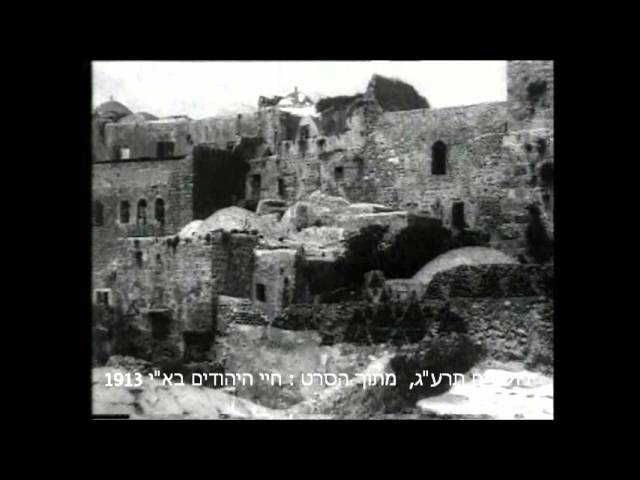
ירושלים מאוחדת לפני 100 שנה 1913 JERUSALEM
